Limits and plans
Google AI Pro vs Ultra for Antigravity
Google offers Antigravity without a plan, with Google AI Pro and with Google AI Ultra. This guide puts what Google says about each one side by side: the quotas, the Gemini 4 Argon pool, what happens when a quota runs out, and how to see which plan and quota you are on. It does not pick a plan for you; it shows you how to read your own usage first.
Plans and limits change often. Numbers here were checked on the dates listed under Sources; always confirm on the provider’s own pages.
What each plan gives for Antigravity
Every plan starts from the same base. Google lists it as Use of Gemini models, including Gemini 3.8 Flash and other offered Gemini Enterprise models, as the core agent model, and unlimited Tab completions4, and adds that All plans get access to all product features, such as scheduled tasks and the CLI2. What changes between plans is the quota, how often it refills, and some of the models.
- Without a Google AI plan: a meaningful quota, refreshed weekly5, with A weekly rate limit6.
- Google AI Pro7: a high, generous quota, refreshed every five hours until the weekly limit is reached8. A higher weekly rate limit9.
- Google AI Ultra10: the highest, most generous quota, refreshed every five hours, with the highest weekly rate limits11; Google’s list also says The highest weekly rate limits12. Access to third-party models13.
Two things follow from that wording. Without a plan, Google describes a quota that refreshes weekly; it mentions a five-hour refresh only for Pro and Ultra. On those two plans the weekly limit sits above the five-hour refill as a ceiling. Google also says Rate limits and model availability differ based on your Google AI plan1, so the models you see in the selector can differ by plan.
Quota groups and the Gemini 4 Argon pool
Whichever plan you are on, the quota is split by model family. Google’s models page describes the selector this way: The model selector shows quota per group (Gemini Models; Claude and GPT models), each with a Weekly Limit Remaining and a Five Hour Limit Remaining14. A Gemini model draws on the Gemini group, and a Claude or GPT model draws on the other, so one group can run out while the other still has room.
Gemini 4 Argon is tied to the paid plans: Gemini 4 Argon is available for Google AI Pro and Ultra in Google Antigravity3. On the models page it is listed as Available with paid Google AI Pro plans or on trial with eligible premium devices15. Without Pro or Ultra, Google does not list Argon, so there is no Argon pool to track. With either plan, the CLI shows it on its own: Antigravity 1.3.x also reports Gemini 4 Argon as a separate quota pool under a GEMINI 4 ARGON header, reported as its own weekly limit.
Agent Tank reads all of this from the CLI’s quota screen. Limits are grouped by the section they appear under (GEMINI MODELS, CLAUDE AND GPT MODELS, …), and shared labels such as Weekly Limit are qualified with their group. The Argon pool is the Gemini 4 Argon Weekly Limit window, with model: "Gemini 4 Argon". In the sample, the groups are Gemini, Claude and GPT and Gemini 4 Argon. Antigravity quotas explained covers the five-hour and weekly limits of each group in depth.
Google publishes relative quotas, not numbers
This is the main limitation of any Antigravity plan comparison. Google’s plans page describes each quota in words that only make sense next to each other: “meaningful”, “high, generous”, “higher”, “highest, most generous”. It gives no number of prompts, tokens or tasks for any plan, and no ratio between them. So nobody can tell you from Google’s pages how many times more work Ultra allows than Pro, or Pro than no plan. This guide gives no estimate either.
Google explains why a fixed number would mislead anyway: The rate limits correlate with the amount of work done by the agent16. You receive more prompts when your tasks are straightforward and the agent can complete the work quickly, while more complex tasks consume more quota17. The limits themselves can move: The baseline rate limits are primarily determined by available capacity and exist to prevent abuse18, and Usage limits for this service are subject to modification19.
What you can measure is how your own work fills your own quota. Agent Tank reports it as remaining_percent: Always 100 - used_percent, so the two add up to 100. Antigravity's reported remaining percentage is kept as-is and used_percent is derived from it. A percentage of your current plan’s quota is not a unit you can carry to another plan, but it tells you how often you run into the ceiling you have.
Overages and AI credits
When a quota runs out, Google documents paid overages rather than extra quota. Users on Google AI Pro or Ultra plans can use purchased AI credits20. The setting that controls it: Once a model’s baseline quota is exhausted, the AI Credit Overages setting decides: Never (wait until the baseline quota refreshes) or Always (use purchased AI credits, consumed at standard Gemini Enterprise consumption pricing)21.
In the CLI, The CLI’s useG1Credits setting (off by default, not available for business accounts) uses your AI credits for model requests after your plan’s quota runs out22. To see the balance, /credits shows remaining G1 credits and purchase links23. One more limit applies on every plan: There is currently no support for bring-your-own-key (BYOK) or bring-your-own-endpoint for additional rate limits24.
Agent Tank does not track Antigravity credits. How it fills credits for this provider: Always null. Run /credits in agy to see the balance.
Which plan and quota you are on
In the Antigravity CLI
The startup banner of agy shows the plan next to your account. Type /usage for the quota: Google’s CLI reference lists it as /usage (alias /quota): display model quota usage25. Each group shows its remaining percentage with “Refreshes in” or “Quota available” under each limit. In the desktop app, You can view baseline quota usage across models on the Settings page26.
In Agent Tank
Agent Tank keeps the plan from that banner: The plan shown next to the account in Antigravity's startup banner, lowercased ("google ai pro"); null when no plan is shown. The dashboard card shows it at the top, above every quota group and the Argon pool:
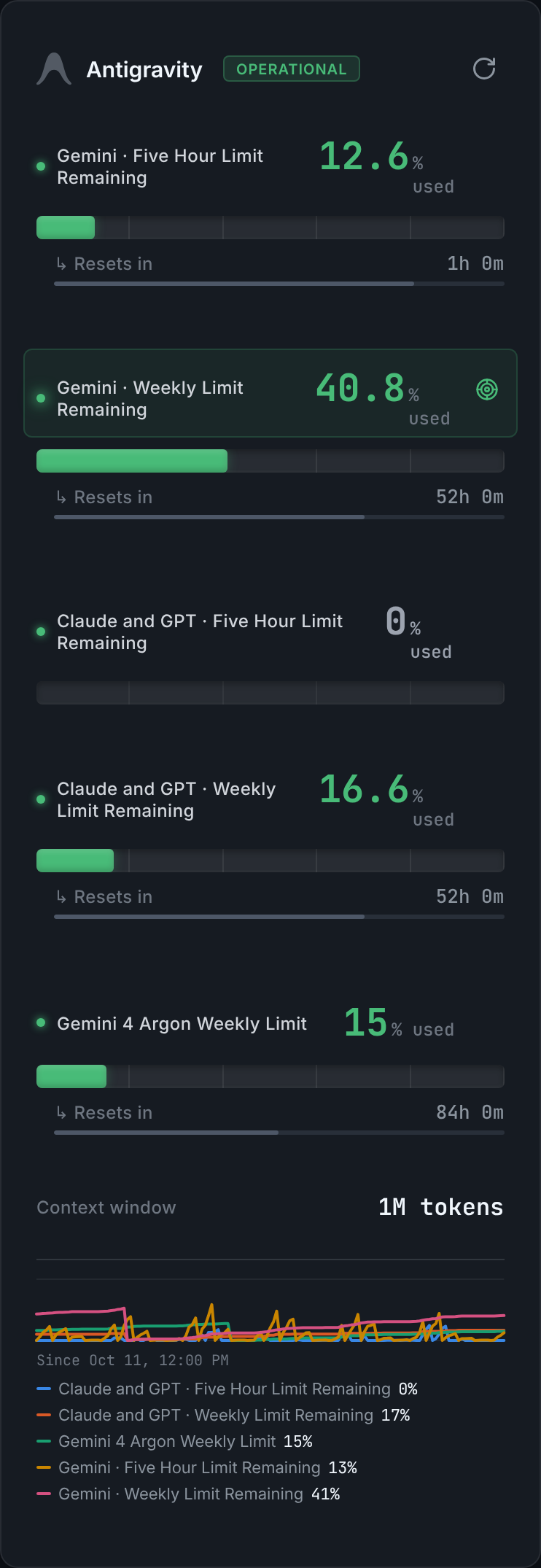
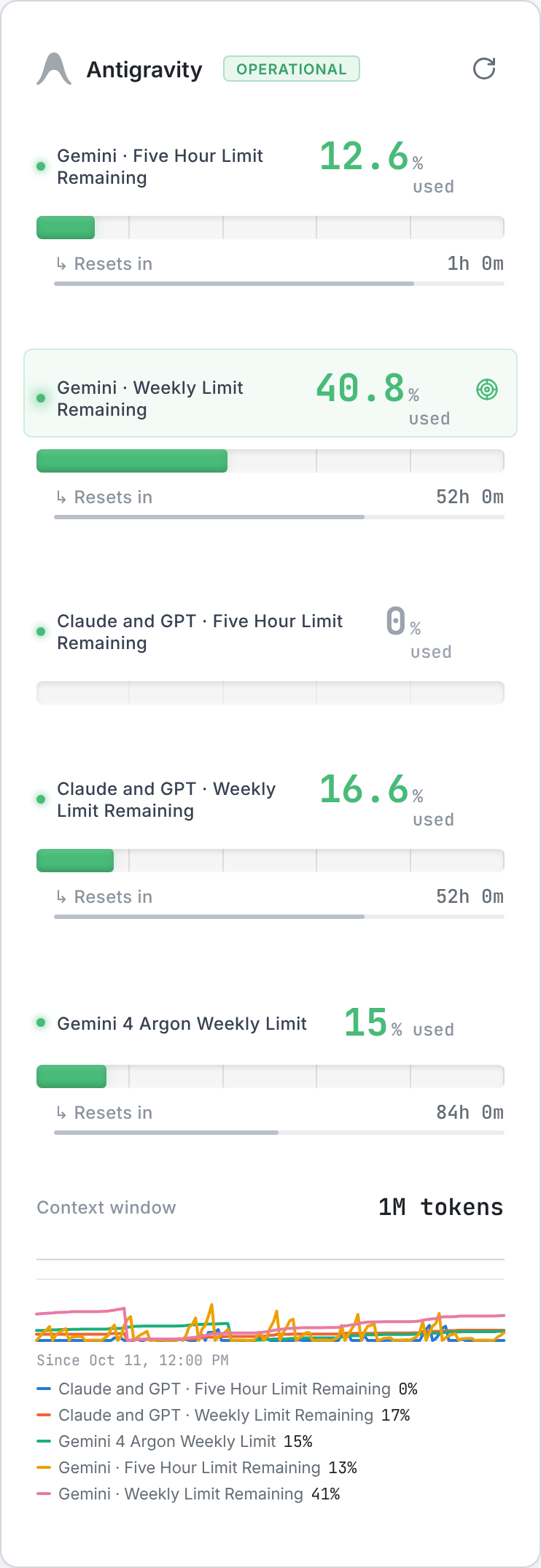
The same data from the local API, trimmed to the plan and the groups:
curl -s http://127.0.0.1:3456/status/agy | jq '{plan, windows: [.windows[] | {model, type, remaining_percent}]}'{
"id": "agy",
"plan": "google ai pro",
"windows": [
{
"label": "Gemini · Five Hour Limit Remaining",
"model": "Gemini",
"type": "five_hour",
"remaining_percent": 87.37
},
{
"label": "Gemini · Weekly Limit Remaining",
"model": "Gemini",
"type": "weekly",
"remaining_percent": 59.24
},
{
"label": "Claude and GPT · Five Hour Limit Remaining",
"model": "Claude and GPT",
"type": "five_hour",
"remaining_percent": 100
},
{
"label": "Claude and GPT · Weekly Limit Remaining",
"model": "Claude and GPT",
"type": "weekly",
"remaining_percent": 83.42
},
{
"label": "Gemini 4 Argon Weekly Limit",
"model": "Gemini 4 Argon",
"type": "weekly",
"remaining_percent": 84.97
}
]
}A plan of null means the banner showed none: Plan the CLI reports, lowercased: the Codex plan type ("plus"), Claude's /status login method ("max"), or the plan next to the account in Antigravity's startup banner ("google ai pro"). If Claude doesn't report a plan, it falls back to "max" when a weekly Fable window is present, and null otherwise.
Read your own usage before choosing
Since Google gives no figures, your own usage history is the only data you have about how much quota your work needs. Agent Tank records every group as its own series and keeps 14 days of it (usage history). After a week or two of normal work, check:
curl -s 'http://127.0.0.1:3456/history/agy?view=chart' | jq '.series[] | {key, points: (.points | length)}'- Which group runs low. If only the Gemini group gets close to empty, switching model family may already cover it. If both groups do, the quota as a whole is what limits you.
- Five-hour or weekly. A five-hour limit that empties and refills is a different problem from a weekly limit that reaches zero mid-week. Without a plan, Google describes only a weekly refresh.
- The Argon pool. If you work mostly in Gemini 4 Argon, its weekly window is the one to watch, separately from the Gemini group.
- Overage settings. Before you change plan, check whether AI credit overages are set to Never or Always, since that decides what happens when a quota runs out.
These checks tell you where you hit limits, not which plan to buy; that depends on your work and budget. For ways to stretch the quota you already have, see how to avoid running out of limits mid-task. Claude vs Codex vs Antigravity sets Antigravity’s groups next to the other two providers’ limits, the Antigravity CLI usage limit tracker page covers how Agent Tank reads agy, and getting started installs it.
Sources
Every plan name, number and limit behaviour above links to one of these official pages.
- Antigravity limits depend on the Google AI plan: antigravity.google/docs/plans (checked )
- Antigravity features on every plan: antigravity.google/docs/plans (checked )
- Gemini 4 Argon availability: antigravity.google/docs/plans (checked )
- What every Antigravity plan includes: antigravity.google/docs/plans (checked )
- Antigravity quota without Google AI Pro or Ultra: antigravity.google/docs/plans (checked )
- Antigravity weekly rate limit without Google AI Pro or Ultra: antigravity.google/docs/plans (checked )
- Antigravity paid plan name: Google AI Pro: antigravity.google/docs/plans (checked )
- Antigravity quota on Google AI Pro: antigravity.google/docs/plans (checked )
- Antigravity weekly rate limit on Google AI Pro: antigravity.google/docs/plans (checked )
- Antigravity paid plan name: Google AI Ultra: antigravity.google/docs/plans (checked )
- Antigravity quota on Google AI Ultra: antigravity.google/docs/plans (checked )
- Antigravity weekly rate limits on Google AI Ultra: antigravity.google/docs/plans (checked )
- Antigravity Google AI Ultra: third-party models: antigravity.google/docs/plans (checked )
- Antigravity quota groups in the model selector: antigravity.google/docs/models (checked )
- Gemini 4 Argon on the models page: antigravity.google/docs/models (checked )
- Antigravity limits depend on agent work, not request counts: antigravity.google/docs/plans (checked )
- Antigravity: complex tasks consume more quota: antigravity.google/docs/plans (checked )
- Why Antigravity has baseline rate limits: antigravity.google/docs/plans (checked )
- Antigravity limits may change: antigravity.google/docs/plans (checked )
- Who can use purchased AI credits in Antigravity: antigravity.google/docs/plans (checked )
- Antigravity behaviour when baseline quota is exhausted: antigravity.google/docs/plans (checked )
- Antigravity CLI useG1Credits setting: antigravity.google/docs/cli/reference (checked )
- Antigravity CLI /credits: antigravity.google/docs/cli/reference (checked )
- Antigravity: no BYOK for extra rate limits: antigravity.google/docs/plans (checked )
- Antigravity CLI /usage: antigravity.google/docs/cli/reference (checked )
- Where Antigravity shows quota usage: antigravity.google/docs/plans (checked )