Limits and plans
Is Claude Max worth it for heavy Claude Code use?
Whether Max pays off depends less on how much you like Claude Code and more on which limit actually stops you, and how often. This guide sets out what Pro and the two Max tiers give for Claude Code, then shows how to read your own session and weekly pace so that you can decide from your own numbers.
Plans and limits change often. Numbers here were checked on the dates listed under Sources; always confirm on the provider’s own pages.
What Pro and Max give for Claude Code
Claude Code is included in all paid plans9, so the question is not access but headroom. The three individual plans that include it:
| Plan | Price per month | Allowance per session | Fable |
|---|---|---|---|
| Pro1 | $202 | The baseline | Usage credits10 |
| Max 5x3 | $1004 | 5x7 Pro | 50% of weekly limits11 |
| Max 20x5 | $2006 | 20x8 Pro | 50% of weekly limits11 |
The Max plan is built for people who work with Claude throughout the day and want longer, uninterrupted sessions12, in Anthropic’s words. Max also gives you higher output limits13. Two practical details: These prices are for web subscriptions only14, and The Max plan is currently available as a monthly subscription only15.
What none of the plans gives is a number you can count. No message counts are published; Max allowances are described only relative to Pro’s per-session allowance16. How much you can do depends on the length and complexity of your conversations, the model you choose, and the features you use, so there’s no fixed message count17. That is why the rest of this guide is about your own usage rather than about the plans. Claude plans compared covers the Free and Team plans as well.
Are you actually limit-bound?
Both Pro and Max plans have a five-hour session limit and a weekly limit18. These limits are shared across Claude and Claude Code19. They stop you in different ways:
- The session limit is the short one. Every plan has usage limits that reset on a rolling five-hour session window20. Hitting it means a pause of hours, not days.
- The weekly limit is the long one. The weekly limit resets at a fixed time each week that is assigned to your account, regardless of when you start using Claude21. Hitting it on day four means waiting the rest of the week.
- The weekly Fable limit only exists on Max: Max plans also have a separate weekly limit for Fable22. In Agent Tank it is the Current week (Fable) window (Max accounts only). The Claude Fable weekly limit on Max covers it in detail.
Being stopped once in a long week is not the same as being stopped every day. What you want to know is which window fills, how often, and how early. Agent Tank adds a pace object to every window to answer the “how early” part:
ratio: Usage rate vs elapsed-time rate (above 1 means usage is out-pacing the window).burning_fast: Whether usage is on track to exhaust the window early.
Here are the session and all-models weekly windows from Agent Tank’s synthetic sample. Both ratios are below 1, so this account is using its allowance more slowly than the clock:
[
  {
    "type": "session",
    "label": "Current session",
    "used_percent": 25,
    "resets_at": "2026-10-17T14:00:00.000Z",
    "pace": {
      "ratio": 0.42,
      "burning_fast": false
    }
  },
  {
    "type": "weekly",
    "label": "Current week (all models)",
    "used_percent": 28,
    "resets_at": "2026-10-22T09:00:00.000Z",
    "pace": {
      "ratio": 0.92,
      "burning_fast": false
    }
  }
]One reading is a snapshot. The usage history keeps 14 days of every window, which is two full weekly cycles, and each dashboard card draws it as a sparkline:
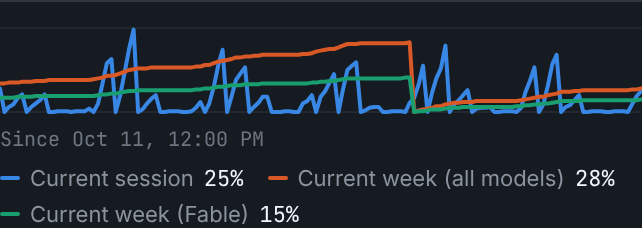
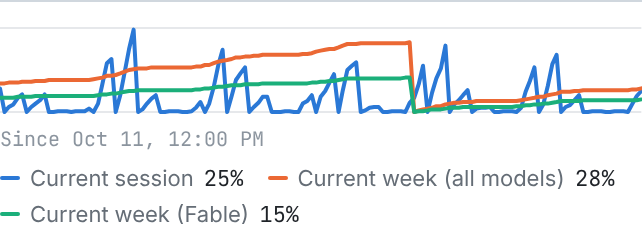
Read it like this. Session peaks that touch the top most days, with the weekly line well below where the week’s clock is, mean you are session-bound. A weekly line that reaches the top before its reset, or a weekly pace.ratio that stays above 1 across both weeks, means you are weekly-bound. On Max, read the Current week (Fable) window the same way: if it reaches the top before its reset while the other two stay below theirs, you are Fable-bound rather than limit-bound overall. After a model-specific message such as “You’ve hit your Opus limit”, switching to a model outside that family with /model keeps you working23. If none of the three happens, you are not limit-bound and a bigger plan would mostly buy unused headroom. To pull the weekly series yourself (history needs Node.js 22.5+):
curl -s 'http://127.0.0.1:3456/history/claude?metric=weeklyAll&view=chart' | jq '.series[0].points | length'A worked example in multiples
Suppose, hypothetically, that on Pro you reach the session limit when only a quarter of the five-hour window has passed. You have used all of the allowance in a quarter of the time, so the session’s pace ratio at that point is 1 ÷ ¼ = 4.
The same work on a larger plan is a smaller share of the allowance, because Max 5x offers five times and Max 20x offers 20 times the Pro plan’s per-session usage allowance24:
- Max 5x3: 4 divided by the 5x7 multiple gives a ratio of 0.8, under 1, so that session would last until its reset.
- Max 20x5: 4 divided by the 20x8 multiple gives 0.2, leaving most of the session unused.
On price, Max 5x3 costs 5 times Pro’s monthly price and Max 20x5 10 times. Put those multiples next to the ratios above and next to your own history; the trade-off is yours to weigh.
Two limits on this arithmetic. First, it assumes the work stays the same, and heavy Claude Code work rarely does. Second, the multiples are stated per session. Anthropic says Max plans also have a weekly usage limit that applies across all models25, but it does not publish how that weekly limit compares with Pro’s, so you cannot divide a weekly ratio the same way. If you are weekly-bound, the example tells you less than your own history after a switch will.
When the API fits instead
A bigger plan is not the only way to get more room. Anthropic lists the options at a limit: Enable usage credits, upgrade (Pro to Max 5x, Max 5x to Max 20x), buy API credits through a Claude Console account, or wait until your usage limits reset26. Anthropic’s pricing page adds: For heavy coding sessions, you can also switch to pay-as-you-go API credits through a Console account27.
Which one fits depends on the shape of your usage. Steady daily overruns are what a larger allowance is designed for. Occasional sprints are where pay-as-you-go can cost less, either as usage credits on your plan (With usage credits enabled, requests switch to pay-as-you-go pricing on usage credits and keep working, billed at standard API rates28) or as a separate API key. Claude subscription vs paying for the API shows how to estimate what a day of Claude Code costs at API prices, so you can compare it with the price multiples above.
One caution if you try both: If the ANTHROPIC_API_KEY environment variable is set, Claude Code uses that key instead of your subscription, resulting in API usage charges rather than using your subscription’s included usage29.
What to check after switching
When upgrading from a lower to a higher tier, your account is charged on a prorated basis for the remainder of your billing cycle30. Once the new plan is active, check that Claude Code and Agent Tank both see it:
- The plan field. On
/status/claude,planis Claude's /status login method, lowercased ("max"). If Claude doesn't report a plan, it falls back to "max" when a weekly Fable window is present, and null otherwise. - The Fable window. On Max a third window appears, with
modelset to"Fable". If it is missing, Claude Code may still be signed in to the old account; If you’re already logged in to Claude Code via Claude Console pay-as-you-go, run /login from within Claude Code to switch to your subscription plan31. - Pace over the next two weeks. Compare the weekly
pace.ratioand the sparkline with the 14 days before the switch. If the weekly ratio is still above 1, the weekly limit, not the session, is what stops you; what happens when you hit the Claude weekly limit covers that case.
If the history after the switch shows you rarely get near any limit, the extra headroom is going unused; that is evidence too, in the other direction. For habits that stretch whichever plan you are on, see how to avoid running out of limits mid-task; for how Agent Tank reads Claude, see the Claude Code usage limit tracker, and getting started to install it.
Sources
Every plan name, number and limit behaviour above links to one of these official pages.
- Claude plan name: Pro: claude.com/pricing (checked )
- Claude Pro price per month, billed monthly (USD): claude.com/pricing (checked )
- Claude plan name: Max 5x: support.claude.com/en/articles/11049741-what-is-the-max-plan (checked )
- Claude Max 5x price per month (USD, web): support.claude.com/en/articles/11049741-what-is-the-max-plan (checked )
- Claude plan name: Max 20x: support.claude.com/en/articles/11049741-what-is-the-max-plan (checked )
- Claude Max 20x price per month (USD, web): support.claude.com/en/articles/11049741-what-is-the-max-plan (checked )
- Claude Max 5x per-session allowance as a multiple of Pro: support.claude.com/en/articles/11049741-what-is-the-max-plan (checked )
- Claude Max 20x per-session allowance as a multiple of Pro: support.claude.com/en/articles/11049741-what-is-the-max-plan (checked )
- Claude Code included in paid Claude plans: claude.com/pricing (checked )
- Fable on the Pro plan (pricing table): claude.com/pricing (checked )
- Fable on Max 5x and Max 20x (pricing table): claude.com/pricing (checked )
- Who Anthropic says the Max plan is for: claude.com/pricing (checked )
- Claude Max output limits: claude.com/pricing (checked )
- Claude Max prices apply to web subscriptions: support.claude.com/en/articles/11049741-what-is-the-max-plan (checked )
- Claude Max billing period: support.claude.com/en/articles/11049741-what-is-the-max-plan (checked )
- Claude message counts per plan: support.claude.com/en/articles/11049741-what-is-the-max-plan (checked )
- What decides how far a Claude plan stretches: claude.com/pricing (checked )
- Claude Pro and Max limit types: support.claude.com/en/articles/11145838-use-claude-code-with-your-pro-or-max-plan (checked )
- Claude and Claude Code share limits: support.claude.com/en/articles/11145838-use-claude-code-with-your-pro-or-max-plan (checked )
- Claude session window is rolling: claude.com/pricing (checked )
- Claude weekly limit reset time: support.claude.com/en/articles/11049741-what-is-the-max-plan (checked )
- Claude Max separate weekly Fable limit: support.claude.com/en/articles/11145838-use-claude-code-with-your-pro-or-max-plan (checked )
- Claude Code model-specific limit messages: code.claude.com/docs/en/costs (checked )
- Claude Max allowance relative to Pro: support.claude.com/en/articles/11049741-what-is-the-max-plan (checked )
- Claude Max all-models weekly limit: support.claude.com/en/articles/11049741-what-is-the-max-plan (checked )
- Claude options when you reach a limit: support.claude.com/en/articles/11145838-use-claude-code-with-your-pro-or-max-plan (checked )
- Claude Code on Console API credits for heavy sessions: claude.com/pricing (checked )
- Claude usage credits after a limit: support.claude.com/en/articles/12429409-manage-usage-credits-for-paid-claude-plans (checked )
- ANTHROPIC_API_KEY takes precedence over a Pro or Max subscription: support.claude.com/en/articles/11145838-use-claude-code-with-your-pro-or-max-plan (checked )
- Claude Max upgrades are prorated: support.claude.com/en/articles/11049741-what-is-the-max-plan (checked )
- Switch Claude Code from Console to a subscription with /login: support.claude.com/en/articles/11145838-use-claude-code-with-your-pro-or-max-plan (checked )